
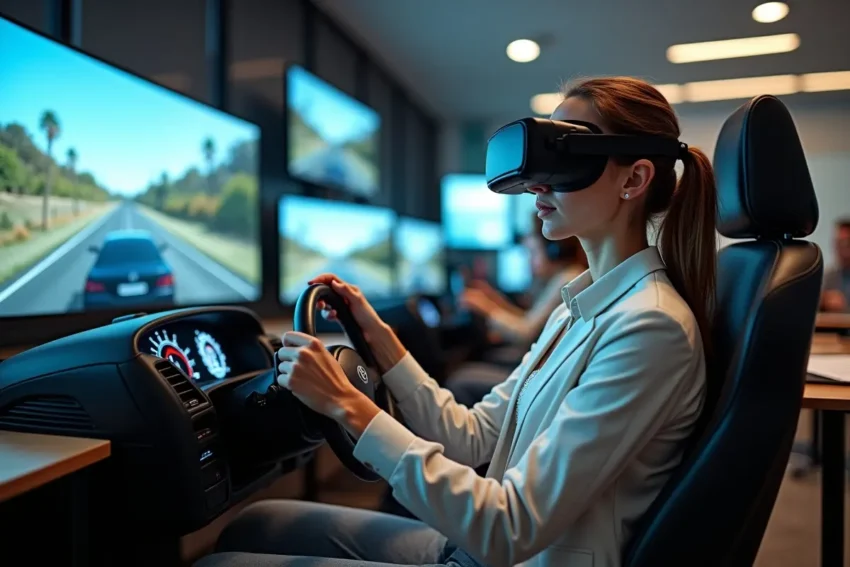
Drivers safety are more important than ever in a fast-moving world where a single lapse in attention can lead to life-altering consequences. Traditional driver education, focused mainly on classroom learning and controlled road experience, often struggles to prepare drivers for split-second decisions in unpredictable situations.
Simulation-based training has emerged as a cutting-edge solution, immersing learners in real-world scenarios within a safe, controlled environment. For example, a law enforcement driving simulator provides officers with a risk-free way to hone their responses to emergencies.
This approach equips drivers with the ability to react quickly under pressure while sharpening their situational awareness. Unlike on-road practice, simulation-based training allows for repetition under a variety of hazardous conditions that would be unsafe to recreate in reality. As more organizations adopt this technology, the evidence grows in favor of its effectiveness for both novice and experienced drivers.
Introduction to Simulation-Based Training
Simulation-based driver training harnesses computer technology to place learners in lifelike driving environments. These simulations go beyond static lessons, providing a virtual steering wheel and dashboard that mirror the controls of a real vehicle. Whether for personal driving, commercial fleet operations, or specialized occupations like law enforcement, modern simulators enable trainees to practice, make mistakes, and learn from them without any danger to themselves or the public.
Simulators are especially effective for preparing drivers for extreme circumstances such as ice, heavy traffic, or high-speed pursuits. By eliminating real-world risks, instructors have the flexibility to expose users to rare but critical incidents as often as necessary for mastery. In recent years, simulation-based training has been adopted in diverse settings, including commercial trucking schools and emergency response agencies.
Enhancing Hazard Anticipation Skills
Hazard anticipation is a core skill that determines driver safety and decision-making on the road. Simulation-based programs present drivers with realistic, sudden hazards like jaywalking pedestrians, erratic vehicles, or debris on the road. Immediate feedback from the simulator and instructors helps students recognize and correct mistakes in real time, reinforcing proper habits and reactions before transitioning to on-road driving.
Research published in the journal Applied Sciences shows simulation-based learning substantially improves a driver’s ability to anticipate, recognize, and avoid hazards. This is particularly valuable for first responders and public safety officers, who must make split-second decisions in high-risk environments. Simulation allows all drivers, regardless of experience, to hone instinctive reactions that significantly lower the risk of traffic incidents.
Replicating Diverse Driving Conditions
One of the main strengths of simulation-based training is its ability to mimic countless driving environments and weather scenarios. In a matter of minutes, an instructor can guide trainees through city traffic, winding country roads, or challenging winter weather. The flexibility to experience multiple scenarios within one training session leads to greater adaptability and confidence for drivers of all levels.
The Volpe National Transportation Systems Center developed a driver simulator capable of creating high-risk events, such as sudden stops, vehicle malfunctions, or poor visibility, that would be hazardous to attempt in real traffic. With such simulators, both trainees and researchers can safely study human reactions in controlled settings and apply those lessons to real-world driver education and safety measures.
Cost-Effectiveness and Efficiency
Aside from enhancing safety outcomes, simulation-based training delivers significant cost savings. Traditional training methods require fuel, physical vehicles, maintenance, and time spent waiting for appropriate conditions. Simulators eliminate these logistics, offering a repeatable, customizable experience that shortens the learning curve and allows for more targeted training.
Organizations can customize simulator scenarios to match the most common hazards in their region or sector, allowing for more efficient remediation of weaknesses and gaps among trainees. This targeted repetition leads to greater proficiency, more rapid skill acquisition, and lower operational costs over the life of a training program.
Real-World Impact and Statistics
Extensive research confirms the real-world impact of simulation-based driver education. A comprehensive review in Applied Sciences concluded that drivers who participated in simulator-based programs experienced substantially fewer on-road incidents compared to those trained with traditional methods. Many commercial and public safety agencies report a reduction in preventable vehicle accidents following the adoption of simulation technology.
Simulation-based training is poised to play an increasingly prominent role in saving lives and reducing injuries on the road. The article outlines how immersive and interactive tech is transforming driver behavior for the better across many sectors.
Conclusion
Simulation-based driver training offers a modern, effective approach to reducing risk and improving performance behind the wheel. By allowing learners to face critical scenarios head-on in a safe virtual space, simulators enhance hazard awareness, build adaptive skills, and provide measurable improvements in real-world driver safety. As adoption continues to grow, simulation training is set to become the standard for responsible driver education in both public and private sectors.