
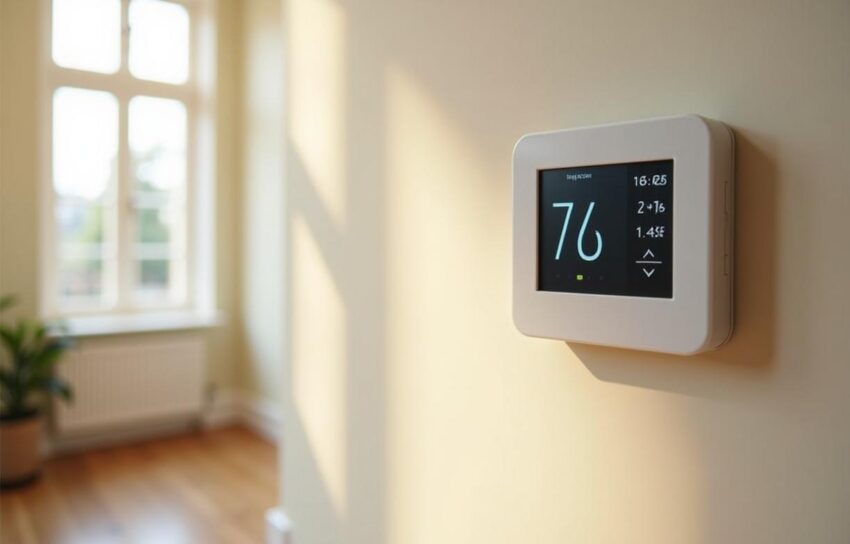
A thermostat can cut heating use only when its schedule matches the way heat moves through your home. The biggest savings come from longer temperature setbacks, not from tiny one-degree tweaks every hour.
The U.S. Department of Energy says households can save about 10% a year on heating and cooling by setting the thermostat back 7°F to 10°F for 8 hours a day. ENERGY STAR also recommends scheduled setbacks, especially during sleep and work hours. The right plan depends on your heating system, insulation, daily routine, and comfort limits.
Start with the best winter temperature targets
For occupied winter hours, set the thermostat to 68°F when people are home and awake. This aligns with U.S. Department of Energy guidance and keeps most homes comfortable with normal clothing. If older adults, infants, or people with health issues live there, use 69°F to 72°F instead. Drafty rooms may also need air sealing before lower settings feel reasonable.
At night, try 60°F to 65°F for at least 7 hours. Start at 65°F for three nights, then lower it by 1°F every two nights if everyone sleeps well. Stop when someone wakes cold, condensation appears on windows, or a room drops below 60°F. Bedrooms above garages and corner rooms usually cool faster than interior rooms.
During work or school hours, use 58°F to 62°F if the home is empty for 8 hours or longer. For shorter absences of 3 to 5 hours, use a smaller setback of 4°F to 6°F. Big setbacks work best when the home stays empty long enough to offset reheating time. A programmable thermostat settings plan should match real occupancy, not an ideal weekday schedule.
Build a schedule around how long the house is empty
Heating savings depend on the number of setback hours. A two-hour dip during dinner will not do much. An eight-hour overnight setback usually matters. A second daytime setback can double the useful hours, if no one is home.
Set the morning “wake” time 30 to 60 minutes before people get up for forced-air heat. Radiators and radiant floors may need 60 to 120 minutes. Heat pumps may need a gentler approach, because large temperature jumps can trigger backup resistance heat. Check your thermostat display for “AUX,” “EM HEAT,” or “Backup Heat” during recovery.
Weekday schedule for a forced-air furnace
Use 68°F from 6:00 a.m. to 8:00 a.m. if people leave after breakfast. Set 60°F from 8:00 a.m. to 4:30 p.m. while the home is empty. Return to 68°F from 4:30 p.m. to 10:00 p.m. Then drop to 62°F from 10:00 p.m. to 6:00 a.m.
If the house warms quickly, shorten the morning recovery by 15 minutes. If rooms lag behind, start recovery 15 minutes earlier. Make one change every three days, because outdoor weather can hide the effect of a single adjustment. Keep the fan set to “auto” unless a specific room needs air circulation.
Weekend schedule for occupied homes
Use fewer changes on weekends if people stay home. Set 68°F from 7:00 a.m. to 11:00 p.m. Then use 62°F overnight. If everyone leaves for errands for more than 5 hours, use a temporary hold at 60°F.
Avoid constant overrides. A “hold until” setting works better than a permanent hold. Permanent holds often erase the savings from the planned schedule. If overrides happen daily, the schedule needs adjustment.
Choose the right setback by heating system
Different heating systems respond differently to setbacks. Furnaces recover fast, while radiant slabs recover slowly. Heat pumps need special attention because backup heat can erase part of the benefit. The Air-Conditioning, Heating, and Refrigeration Institute notes that heat pump performance depends heavily on outdoor temperature and system type.
| Heating setup | Best occupied setting | Best setback | When it fits |
|---|---|---|---|
| Gas forced-air furnace | 68°F | 58°F to 62°F | Empty home for 6+ hours |
| Boiler with radiators | 68°F | 60°F to 64°F | Predictable schedule and slow rooms |
| Air-source heat pump | 67°F to 68°F | 63°F to 66°F | Mild climates or smart recovery controls |
| Radiant floor slab | 67°F | 64°F to 66°F | Long, steady occupancy |
| Poorly insulated home | 69°F | 62°F to 65°F | Drafts or rapid temperature drops |
For heat pumps, limit large temperature jumps
If you have an air-source heat pump, avoid an 8°F morning jump unless the thermostat controls auxiliary heat well. Use a 2°F to 4°F setback first. Watch the thermostat during recovery on cold mornings below 35°F. If “AUX” stays on for more than 30 minutes, reduce the setback.
Many newer smart thermostats have heat pump balance settings. Choose the efficiency-focused mode if comfort remains acceptable. Do not use emergency heat for normal recovery. Emergency heat usually relies on electric resistance strips and should be reserved for equipment problems.
Use thermostat features that actually save heat
Smart recovery, adaptive recovery, and early start features learn how long your home takes to warm. Enable one of these features if your schedule is consistent. The thermostat may start heating before the scheduled time, but it targets comfort at the exact wake or return time. This works best after one to two weeks of normal operation.
Lock out extreme manual changes if your thermostat allows temperature limits. Set the heat maximum at 70°F or 72°F for shared households. ENERGY STAR certified smart thermostats must demonstrate energy savings using a full year of real-world field data, not only lab claims. That certification helps separate useful controls from basic Wi-Fi remotes.
Set the thermostat location and sensors correctly
A thermostat should sit on an interior wall about 52 to 60 inches above the floor. Keep it away from supply vents, exterior doors, fireplaces, sunny windows, and kitchen appliances. Bad placement can make the system short-cycle or overheat the rest of the home. If relocation is not practical, use remote room sensors.
Place sensors in occupied rooms, not hallways. Bedrooms need sensor priority at night if sleep comfort matters most. Living areas should take priority during evening hours. Do not average a cold basement sensor with a warm second-floor bedroom unless both spaces need the same comfort level.
Decide which setting strategy fits your home
Pick an aggressive schedule if the home is empty most weekdays and has a fast heating system. That means 68°F when occupied, 58°F to 60°F during an 8-hour absence, and 60°F to 62°F overnight. This fits gas furnaces, propane furnaces, and many well-sized hot-air systems. It also fits homes that regain 6°F in under 90 minutes.
Pick a moderate schedule if someone works from home part time, the house has radiators, or rooms cool unevenly. Use 68°F while occupied and 62°F to 64°F during sleep or absences. This avoids long recovery periods in dense plaster, masonry, and older hydronic systems. It also reduces complaints from rooms at the end of duct runs.
Pick a minimal-setback schedule if you have a heat pump, radiant slab, or medically sensitive occupants. Use 67°F to 69°F while occupied and 64°F to 66°F during setbacks. This keeps surfaces warmer and limits backup heat. It also works for homes with humidity issues, where cold interior surfaces can lead to condensation.
Check results without guessing
Compare heating use over similar weather, not calendar days alone. Use heating degree days from the National Weather Service or a utility portal if available. A week with 25°F average outdoor temperatures will use more heat than a week averaging 40°F. Compare therms, gallons, or kilowatt-hours per heating degree day.
Run each schedule for at least 14 days before judging it. Track wake comfort, evening comfort, and whether recovery uses backup heat. Note any room that stays more than 3°F below the thermostat setting after 60 minutes. That room may need duct balancing, radiator bleeding, weatherstripping, or added insulation.
If pipes run through exterior walls, crawl spaces, or unheated basements, keep the main thermostat at 55°F or higher during travel. Open cabinet doors under sinks on exterior walls. Shut off and drain vulnerable outdoor lines before hard freezes. The Insurance Institute for Business & Home Safety recommends protecting pipes before temperatures stay below freezing for extended periods.