
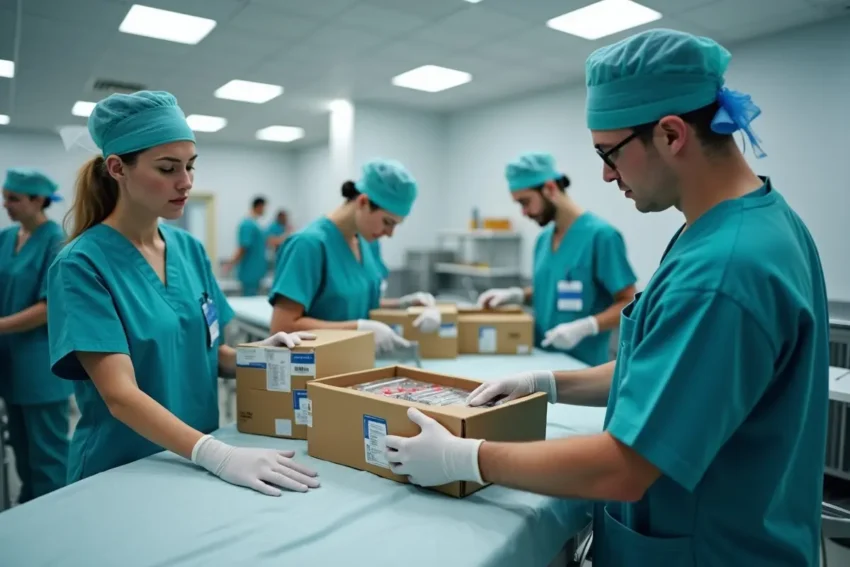
The choices we make in managing the flow of supplies, equipment, and products aren’t just about budget or storage space. They’re about ensuring that clinicians have what they need, when and where they need it, to drive the best possible patient outcomes.
The window is narrower than it used to be
Traditional pharmaceuticals were far more forgiving in comparison. The shift toward biologics, gene therapies, and personalized medicine has changed that completely. These products do not just prefer stable temperatures, they depend on them to remain viable. A thermal swing of two degrees Celsius over a few hours can be enough to compromise an entire shipment. The product looks the same. The packaging is untouched. But the contents are worthless.
That is what makes it a silent failure, and it falls into a risk category that standard logistics setups were never built to catch. When you are moving routine, non-critical supplies, a disruption is an inconvenience. When the cargo is patient-specific biologics or temperature-sensitive equipment, a delay or a temperature shift can mean writing off the whole treatment, and the patient is the one who pays for it.
The data trail is now part of the product
In other times, speed would be the primary metric and key objective when it came to medical logistics. Being able to provide service to patients quickly and provide necessary equipment for doctors is still important, but there are other considerations to make now. Compliance with stringent healthcare regulations is now a key element of logistical processes. This means keeping auditable records of every product and piece of equipment, showing it is fit for use and safe to administer to a patient.
This is where data loggers and real-time monitoring have moved from nice to have to non-negotiable. IoT-enabled tracking gives supply chain teams live visibility into temperature, humidity, and location data throughout transit. But the real value is not just operational, it is evidentiary. Good Distribution Practice standards require that documentation exists and that it holds up under scrutiny. A facility that cannot produce a complete data trail for a compromised shipment is not just dealing with spoiled stock, it is sitting on a compliance gap.
According to the World Health Organization, approximately 25% of vaccines reach their destination in a degraded state because of incorrect shipping and broken cold chains. That figure represents failed patient protection at scale, and it reflects what happens when logistics is treated as separate from clinical governance rather than integral to it.
Putting the compliance issue aside, the spoiled stock of medication, including essential products like vaccines, represents a failure to protect and help patients. This underlines the real issue that occurs from poor logistical planning and a lack of proper infrastructure to meet medical standards. This is a much more palpable way to underline the importance of proper planning.
Storage is where silent failures begin
Most thermal excursions don’t happen in transit. They happen in storage – during the periods between movement, in facilities that weren’t designed for the sensitivity of modern medical products, or with equipment that was never validated for the purpose it’s serving.
Validation protocols like IQ, OQ, and PQ exist specifically to prove that medical storage equipment actually performs under real-world conditions. A unit that passes a manufacturer spec test in a controlled environment can behave very differently in a warehouse where the temperature swings every time the loading dock opens and closes. Without formal validation in place, that kind of discrepancy goes unnoticed until something fails further down the line.
Rollex Medical specializes in the kind of high-specification medical-grade storage solutions that support these validation requirements, providing the temperature-controlled environments that modern biologics and medical equipment demand. That specificity matters. General-purpose cold storage isn’t the same thing, and treating it as equivalent is one of the more common and costly assumptions in healthcare supply chains.
Proactive risk beats reactive recovery
The reactive approach to supply chain risk in healthcare is unfortunately the most common. Something goes wrong, the incident gets investigated, a new procedure gets written. Wash, rinse, repeat. The problem is that in medical logistics, reactive is expensive in ways that go beyond inventory shrinkage. A spoiled shipment of a biologic isn’t just a financial write-off. It’s a patient who waits longer, a treatment window that closes, a provider who carries that outcome forward.
The increased use of predictive analytics helps to change the risk profile involved in healthcare supply chains. Analysis teams nowadays have access to historical data regarding the performance of equipment and things like storage environment suitability for different products. They have detailed information regarding the reliability and performance of logistical partners who carry and transport products. By having all this information to hand, teams can reduce degrees of failure in areas like human picking and packing and improper storage methods for sensitive products like vaccines.
Logistics is clinical decision-making
The level of detail upon which a clinician will make a diagnosis and prescribe treatment is mirrored in the supply chain decisions that are made in preparation for every patient encounter. Organizations that understand this tend to experience fewer compliance issues, incur less inventory shrinkage, and possess greater awareness whenever an issue does occur.
It wasn’t the doctor that failed the outcome. Nor was it the nurse. It was the warehouse at 2 am, and no one was the wiser. This is the risk that modern healthcare logistics is designed to mitigate.