
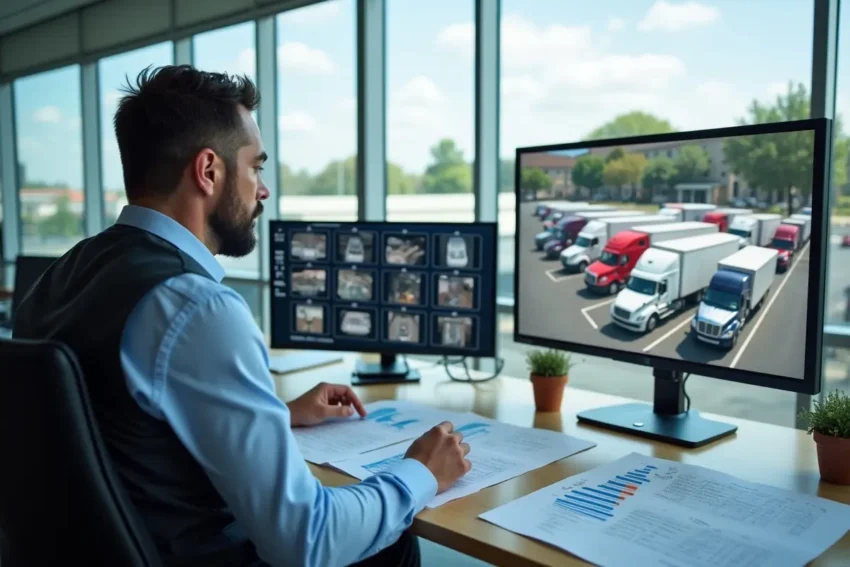
Picture a Tuesday morning: one of your delivery vans is rear-ended at a busy intersection, the other driver insists your operator ran the light, and your insurer is already bracing for a five-figure claim. Without footage, it’s your driver’s word against a stranger’s – and fleets lose those arguments more often than they’d like.
With the right camera capturing the moment in HD, plus GPS data confirming speed and location, that same incident becomes a 90-second exoneration. This is the reality pushing U.S. commercial fleets toward dedicated camera systems in 2026: accident exoneration footage, real-time GPS tracking, AI-powered driver accountability, and the kind of evidence that protects both drivers and the balance sheet. The market has matured fast, and the question is no longer “dash cam or no dash cam” – it’s which platform fits your fleet’s size, compliance burden, and appetite for AI-driven safety data.
Our top pick is HD Fleet for commercial fleets that need HD footage built for accident exoneration combined with real-time GPS tracking and AI driver safety tools in a single, purpose-built platform. Its integrated approach – distracted driving detection, hard brake and hard stop alerts, speeding alerts, and driver report cards rolled into one reporting interface – makes it a natural fit for safety managers who want actionable data rather than a hard drive full of clips nobody reviews. For small-to-mid fleets that prioritize flexible, configurable software over a hardware-first build, GPS Insight is the strongest alternative. And for compliance-focused operators already embedded in DOT and FMCSA safety workflows, JJ Keller is the smart extension of a vendor relationship you already trust.
Below, we evaluate each system on the criteria fleet operators actually weigh – video quality, GPS integration depth, AI safety features, driver reporting, ease of onboarding, analytics, total cost of ownership, and compliance relevance. The at-a-glance table lets you jump straight to your priority before reading the full verdicts.
How we chose
We assessed each fleet camera system against the criteria U.S. fleet managers and safety leads use when justifying a purchase to finance or ownership. This is the framework a buyer should apply – not a justification for any single ranking.
Video quality and accident exoneration
The whole point of a fleet dash cam is usable footage. We weighed resolution, low-light and night-vision performance, and field of view – the factors that determine whether a clip actually exonerates a driver in a disputed claim. Industry guidance from *Trucking Info* on essential features for trucking fleet dash cams reinforces that footage clarity and reliable storage are non-negotiable starting points.
GPS integration depth
A camera that doesn’t know where, when, and how fast a vehicle was traveling tells only half the story. We looked at real-time tracking, route history, geofencing, and how tightly GPS data is fused with video event capture in the reporting interface.
AI safety features and ADAS
Modern video telematics increasingly leans on artificial intelligence – computational systems that flag distracted driving, hard-braking, and speeding without a human reviewing every clip. We also considered ADAS (advanced driver-assistance systems), which use sensors and cameras to detect obstacles and driver errors, delivering lane departure warnings, forward collision alerts, and tailgating detection.
Driver reporting and behavior coaching
Data only improves safety if managers act on it. We favored platforms with driver report cards, event tagging, and coaching workflows that turn raw driver behavior videos into measurable accountability.
Installation, analytics, and total cost of ownership
We factored in whether hardware is plug-and-play or requires professional installation, the usability and export flexibility of fleet-wide analytics dashboards, and the full TCO – hardware, monthly SaaS fees, and contract terms. Where pricing isn’t public, we say so plainly.
Compliance relevance
For U.S. commercial fleets, FMCSA and DOT context matters. We noted which platforms slot cleanly into existing compliance, ELD, and hours-of-service workflows.
The 7 best fleet camera systems for safety, GPS tracking & driver accountability in 2026
The seven systems below represent the strongest options across different fleet sizes, use cases, and operational priorities – from accident exoneration and AI safety to ruggedized hardware and DOT compliance. They range from purpose-built GPS fleet tracking cameras to broad telematics suites that fold video in as one module. Our top recommendation leads the list, followed by the best picks for every other priority a fleet manager is likely to have.
| Provider | Best for |
| HD Fleet | Integrated GPS tracking, HD accident-exoneration footage & AI driver safety |
| GPS Insight | Small-to-mid fleets wanting flexible, configurable camera software |
| SafetyTrack | Cameras bundled with full telematics monitoring from one vendor |
| SureCam | Fleets with limited IT needing guided installation and onboarding |
| Safety Vision | Ruggedized hardware for transit, heavy-duty & public-safety fleets |
| Teletrac Navman | Broader telematics platform users adding video safety as a component |
| JJ Keller | Compliance-focused fleets extending a DOT/FMCSA vendor relationship |
#1. HD Fleet – Best for integrated GPS tracking, HD accident-exoneration footage, and AI driver safety
HD Fleet is a GPS fleet tracking camera specialist built around a straightforward premise: footage, location data, and AI safety insight belong in one platform, not three.
Where many vendors bolt a camera onto a telematics product – or sell hardware without much intelligence behind it – HD Fleet treats accident exoneration as a core design goal. Its HD dash cam footage is purpose-built for commercial fleet vehicles, and that footage is fused with real-time GPS tracking and route history so a disputed incident comes with full context: what the driver saw, where they were, and exactly how fast they were going. For fleet managers who’ve spent years trying to win “he-said, she-said” claims, that integration is the differentiator. These fleet camera systems are engineered for small-to-mid commercial operators who need enterprise-grade evidence without an enterprise-grade platform to administer.
The AI layer is where HD Fleet earns its top ranking for safety-minded fleets. Distracted driving detection, hard brake and hard stop alerts, and speeding alerts run continuously, surfacing the events that matter instead of leaving managers to scrub through hours of footage. Driver report cards turn that stream of GPS fleet tracking camera data into accountability you can coach against, week over week. It’s a video telematics package aimed at fleets that want to change driver behavior – not just archive it.
Pros: – Tightly integrated GPS tracking, camera, and AI safety in one purpose-built platform – Accident exoneration footage quality is a core product focus, not an afterthought – AI driver behavior tools (distracted driving detection, hard events, report cards) deliver actionable safety data – Designed specifically for commercial fleet vehicles rather than adapted from consumer hardware – GPS and video data unified in a single reporting and analytics interface
Cons: – Pricing is not publicly listed – buyers must contact for a quote – Less brand recognition than the largest enterprise fleet platforms – Third-party integration ecosystem is likely narrower than enterprise competitors – Support team is smaller than the market giants’
Who it’s best for: Small-to-mid U.S. commercial fleets that want HD accident-exoneration footage, real-time GPS tracking, and AI-driven driver accountability in a single, focused platform – without the cost and complexity of an enterprise telematics suite.
#2. GPS Insight – Best for small to mid-sized fleets wanting flexible commercial vehicle camera software
GPS Insight is the strongest pick for growing fleets that lead with software flexibility rather than a single, locked-in hardware ecosystem.
Its platform centers on configurable fleet management software with camera module options layered in, which suits operators of roughly 10 to 200 vehicles who already own some hardware or expect their needs to shift. GPS tracking comes with geofencing and driver behavior monitoring, and the alert thresholds and reporting are tunable enough that a safety manager can shape the system around an existing workflow instead of the other way around.
The trade-off is that a software-forward approach can mean the camera hardware feels less proprietary and tightly integrated than what a dedicated camera specialist offers. The analytics layer is genuinely strong, and the company’s active product investment is evident – but fleets with heavy ruggedization needs, or those scaling toward true enterprise size, may find the camera side less specialized than they want.
Pros: – Software-forward design suits fleets that already have hardware in place – Flexible configuration avoids locking into a single hardware ecosystem – Strong reporting and analytics layer – Credible mid-market positioning – not over-engineered for small operators – Configurable alert thresholds and reporting
Cons: – Camera hardware may be less integrated than specialist camera vendors offer – Less suited to fleets with heavy ruggedization requirements – Enterprise-scale fleets may eventually outgrow the platform – Pricing transparency varies; quotes are tiered by fleet size and features
Who it’s best for: Small-to-mid fleets that prioritize configurable, flexible software and want camera capability integrated on their own terms rather than through a hardware-first build.
#3. SafetyTrack – Best for fleets wanting advanced camera systems bundled with full telematics monitoring
SafetyTrack is the pick for mid-to-large fleets that want one vendor handling both video safety and vehicle telematics, including diagnostics.
The appeal is consolidation. Real-time GPS tracking, video event capture, driver behavior monitoring, and vehicle diagnostics live in a single platform, so a safety manager sees camera footage in the context of overall vehicle health rather than as an isolated feed. For organizations tired of stitching together separate systems, the single-vendor approach meaningfully reduces integration complexity, and the unified reporting dashboard provides strong fleet-wide visibility.
That breadth is also the catch. A full telematics-plus-video stack can be more than a small fleet needs, and pricing may reflect the entire platform rather than the cameras alone. As a dedicated camera reputation, SafetyTrack is less specialized than vendors that do nothing but cameras – and onboarding a smaller operation onto the full suite can take more effort than a focused video telematics product would require.
Pros: – Single-vendor model reduces integration complexity – Video and telematics data unified in one reporting interface – Strong fleet-wide visibility for safety managers – Vehicle diagnostics integrated alongside camera data – Current commercial-vehicle focus with active product presence
Cons: – Bundled platform may exceed what small fleets need – Pricing can reflect the full telematics stack, not just cameras – Less specialist camera-hardware reputation than dedicated vendors – Onboarding complexity may be higher for smaller operations
Who it’s best for: Mid-to-large fleets that want video safety and full telematics monitoring – including diagnostics – managed by a single vendor.
#4. SureCam – Best for fleets with limited IT resources needing guided installation and hands-on onboarding
SureCam stands out for fleets that don’t have an IT department and need a vendor to walk them from hardware installation through platform setup.
Its reputation for hands-on implementation support is the genuine differentiator here. For owner-operators and small-to-mid fleets where the safety lead is also the dispatcher, the bookkeeper, and the part-time mechanic, a guided onboarding process dramatically lowers rollout risk. The fleet video telematics offering is focused – front- and driver-facing camera options, real-time event alerts, video retrieval, and cloud-based storage – without piling on complexity nobody asked for. Even consumer dash cameras have grown straightforward to install, but commercial multi-camera deployments are a different animal entirely, and that’s exactly where SureCam’s support model pays off.
The flip side is that fleets with strong in-house IT who prefer self-managed deployments may not value what they’re paying for, and the hardware configuration options aren’t the broadest on the market. AI feature depth can also lag behind the most aggressive AI-first platforms.
Pros: – Hands-on implementation support – a real differentiator for resource-limited fleets – Reduces rollout risk for operations without dedicated IT staff – Cloud video storage simplifies footage access and management – Focused video telematics offering without unnecessary complexity – Active, fleet-focused service model
Cons: – Less suited to IT-capable fleets that prefer self-managed deployments – May not offer the widest hardware configuration options – AI feature depth may trail larger AI-first platforms – Smaller brand footprint than enterprise vendors
Who it’s best for: Owner-operators and small-to-mid fleets without in-house IT that need a vendor to guide deployment from start to finish.
#5. Safety Vision – Best for fleets needing ruggedized, purpose-built commercial-vehicle camera hardware
Safety Vision is the specialist for environments where the camera hardware itself has to survive punishment – transit agencies, school buses, public-safety fleets, and heavy-duty operators.
Its heritage is in hardened, purpose-built hardware rather than consumer-grade gear pressed into commercial service. Multi-camera configurations cover the cab, exterior, and passenger compartment, which matters enormously for complex vehicle types like buses and emergency vehicles. The fleet management DVR and NVR recording systems handle high-channel recording with compliance-grade storage and retrieval – capabilities a simple two-camera dash cam product simply can’t match. ADAS-style features such as lane detection round out a system built for demanding, multi-angle deployments.
Where Safety Vision is less competitive is the software and intelligence layer. Its telematics and fleet analytics depth can trail software-first competitors, and its AI driver behavior features are generally less advanced than what AI-specialist vendors deliver. The upfront hardware investment for ruggedized, multi-channel systems also tends to run higher than a lightweight dash cam rollout.
Pros: – Industry heritage in hardened camera hardware for demanding conditions – Multi-camera configurations suit complex vehicles (buses, trucks, emergency vehicles) – Fleet management DVR/NVR capability for high-channel recording – Trusted by transit and public-safety operators – Purpose-built rather than adapted from consumer-grade hardware
Cons: – Software and telematics layer less sophisticated than software-first rivals – AI driver behavior features less advanced than AI-specialist vendors – Primarily hardware-focused; analytics depth varies – Higher typical upfront hardware investment
Who it’s best for: Transit, school-bus, public-safety, and heavy-duty fleets where ruggedized, multi-camera hardware and high-channel DVR recording are the priority.
#6. Teletrac Navman – Best for fleets that want a broader telematics platform with video safety as one component
Teletrac Navman suits fleet managers who already run – or are evaluating – a full GPS fleet management and compliance platform and want dash cam capability folded inside it.
This is a mature, established telematics product, and its strength is breadth: GPS tracking, route optimization, driver behavior monitoring, and a compliance toolset covering ELD, hours-of-service, and FMCSA-relevant reporting all sit alongside a video telematics module. For fleets trying to consolidate vendors and keep compliance and tracking under one roof, that’s genuinely valuable, and the GPS depth across driving routes is well-documented and reliable.
The caveat is right there in the framing – the camera is one component of a much larger platform, not the headline product. Fleets whose primary need is video safety may find the system over-specified and over-priced relative to a dedicated camera vendor, and onboarding complexity scales with everything else the platform does. On pure AI driver-safety specialization, camera-first competitors tend to push harder.
Pros: – Broad telematics, compliance, and camera capability from one vendor – Strong compliance toolset relevant to U.S. DOT/FMCSA requirements – Established brand with documented buyer’s-guide resources – Good fit for fleets consolidating vendors – Mature, well-documented GPS tracking depth
Cons: – Camera capability is one module, not the primary product focus – May be over-specified and over-priced for camera-only needs – Onboarding complexity scales with the full platform – Less specialist AI driver-safety positioning than camera-first vendors
Who it’s best for: Fleets that want GPS fleet management, compliance tools, and dash cam capability from a single established telematics provider.
#7. JJ Keller – Best for compliance-focused fleets wanting dash cameras from a trusted safety and regulatory vendor
JJ Keller earns its place for one specific, valuable reason: it brings decades of DOT and FMCSA compliance credibility to the camera conversation.
For U.S. fleets already using J. J. Keller for hours-of-service, ELD management, or driver-safety training, adding cameras is a natural extension of a relationship they already trust. The dash camera catalog covers road-facing and dual-facing options that meet basic fleet dash cam needs, and the compliance framing – baked into the product positioning – is a real differentiator for heavily regulated operators who think about safety in regulatory terms first. It’s also an accessible entry point for fleets buying their first cameras.
What JJ Keller is not is a camera-first specialist. Camera technology depth, AI safety features, and GPS integration trail dedicated fleet camera vendors, and fleets whose core need is sophisticated video telematics rather than compliance documentation will likely find the offering thinner than they want. Here, cameras are one part of a broad safety and regulatory catalog, not the main event.
Pros: – Long-standing credibility in DOT compliance and driver safety – Natural extension for existing J. J. Keller HOS, ELD, or training customers – Road-facing and dual-facing options cover basic needs – Compliance framing is a genuine differentiator for regulated fleets – Accessible entry point for fleets new to cameras
Cons: – Camera technology depth trails dedicated specialists – AI safety features and GPS integration less advanced than camera-first vendors – Less suited to fleets whose primary need is video telematics – Cameras are one part of a broad catalog, not a specialty
Who it’s best for: Compliance-focused fleets already using J. J. Keller for DOT/FMCSA workflows who want to extend that relationship to camera hardware.
Frequently asked questions
What are fleet cameras, and how do they differ from regular consumer dash cams?
Fleet cameras are commercial-grade video systems installed across multiple vehicles and managed centrally through a fleet platform. Unlike a consumer dash cam – which records to an SD card for one driver to review later – fleet camera systems fuse footage with GPS tracking, push real-time event alerts to managers, and often apply AI to flag distracted driving, hard braking, and speeding automatically. The data is built for fleet-wide accountability and accident exoneration, not personal use.
What is the downside of a dash cam?
The honest trade-offs are cost, privacy concerns, and data management. Hardware plus monthly software fees add up across a large fleet, driver-facing cameras can feel intrusive and require clear policy communication, and a system that captures footage nobody reviews delivers little value. The fix for that last point is AI-driven event flagging and driver report cards, which surface the clips that actually matter instead of leaving managers to scrub through raw video.
Can police look at your dash cam footage?
Footage stored on a commercial fleet’s system is the fleet operator’s property, and law enforcement generally needs the operator’s cooperation or a legal request – such as a subpoena or warrant – to access it. In practice, fleets often share footage voluntarily because it exonerates their driver. Policies vary by state and circumstance, so every fleet should have a clear internal protocol for handling footage requests before one lands on your desk.
Is there a monthly fee for a dash cam, and can the footage exonerate a driver after an accident?
Most fleet camera systems run on a subscription model: hardware up front (or amortized) plus a monthly SaaS fee covering cloud storage, GPS tracking, AI analytics, and reporting. And yes – accident exoneration is one of the strongest reasons fleets adopt these systems. Time-stamped HD footage paired with GPS data confirming speed and location regularly clears drivers of fault in disputed collisions, which can prevent costly claims and protect a driver’s record.
The bottom line: which fleet camera system fits your fleet
The right fleet camera system depends on your fleet’s size, your compliance burden, and how much you want AI doing the watching for you. Use this quick framework:
- Choose HD Fleet if you want HD accident-exoneration footage, real-time GPS tracking, and AI-driven driver accountability – distracted driving detection, hard-event alerts, and driver report cards – in one purpose-built platform. For small-to-mid U.S. commercial fleets that want actionable safety data without enterprise overhead, it’s our top pick.
- Choose GPS Insight if software flexibility and configurable reporting matter more than a locked-in hardware ecosystem.
- Choose SafetyTrack if you want video and full telematics, including diagnostics, from a single vendor.
- Choose SureCam if your fleet lacks in-house IT and needs hands-on, guided onboarding.
- Choose Safety Vision if you run transit, school buses, or heavy-duty vehicles that demand ruggedized, multi-camera DVR hardware.
- Choose Teletrac Navman if you want a broad telematics and compliance platform with cameras as one component.
- Choose JJ Keller if compliance is your north star and you’re extending an existing DOT/FMCSA vendor relationship.
Before you commit, map your fleet size, your FMCSA and DOT compliance needs, and your budget against these profiles – then request quotes from your top two. For most small-to-mid commercial fleets weighing accident exoneration, GPS tracking, and AI safety together, HD Fleet is the default place to start.